The Cyber Campus is a new training program focused on the goal of continuously maintaining and updating the knowledge acquired in the Cyber School.
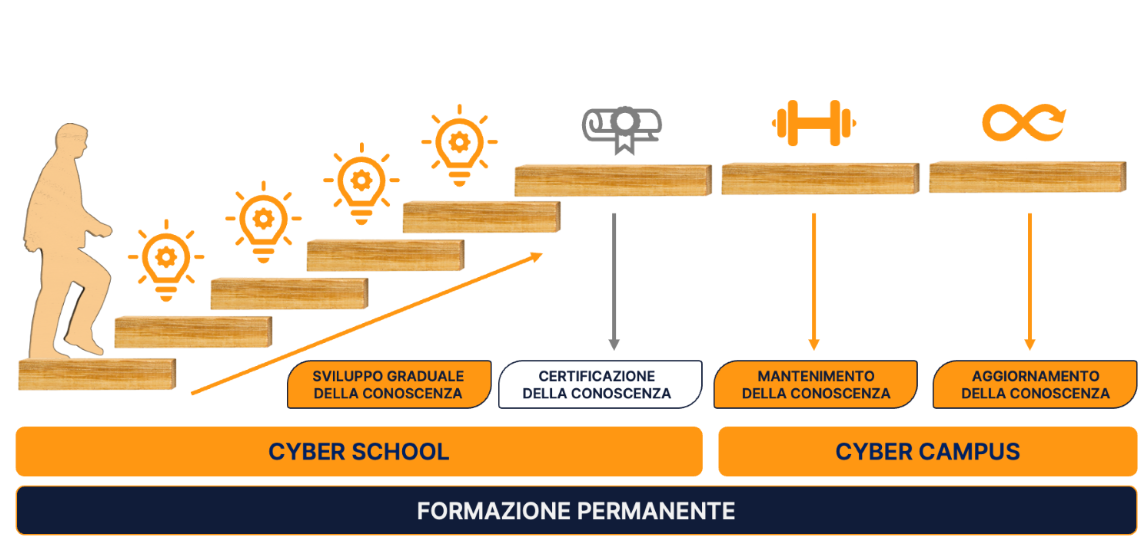
The learning objects (Learning Objects "LO") are designed around an “active” learning model, offering a highly interactive content experience.
These LOs can be grouped into two main categories:
-
Knowledge maintenance LOs, which aim to “train your memory” by focusing on interactivity that generates feedback, making this the main learning driver for these LOs.
-
Update LOs, which use a teaching approach similar to the Cyber School training modules, but are more “focused” on specific topics than the modules themselves.
Types of learning objects in the campus
The first three learning objects fall under the maintenance category, while Cyber Insights belong to the update category.
-
WarmUp – Interactive LOs that are very “light” in terms of content, designed as training exercises, similar to a warm-up phase.
-
DidActive – Interactive LOs with more substantial educational content, focused on memory training through intensive use of feedback.
-
Cyber Game – Interactive LOs that use elements of Serious Games and Game-Based Learning, while still being experienced individually.
-
Cyber Insights are highly focused (vertical) learning objects on a specific topic. The development of these LOs is driven by the evolution of threats and the main attack techniques.
From a training plan perspective, these objects are combined and distributed over time, always with the goal of keeping the training load around 15–20 minutes per month.
Warm-Up
These objects serve as a “review” of knowledge already acquired, with a series of interactions aimed at identifying threats hidden in specific situations, which are illustrated through vignettes.
In Warm-Ups, the learner’s interaction can result in three outcomes:
-
correct answer;
-
partially correct answer;
-
incorrect answer.
No matter the outcome, the learner receives feedback: in the first case, it’s reinforcing; in the second or third, it’s redirecting.
DidActive
These objects have a learning structure designed for maximum training effectiveness within the Cyber Campus program.
They are more challenging than Warm-Ups and require more cognitive effort:
-
the educational component is more developed;
-
the interactions are more sophisticated;
-
they often use a Learning By Doing model, assessing the learner’s behavior.
The learning structure also allows for redirecting knowledge when needed and filling any gaps that may have developed during previous training.
Cyber Game
These learning objects are based on the concept of Serious Games: digital games designed for educational, informational, and training purposes.
They follow the Escape Room model: participants are asked to solve a series of puzzles, riddles, and challenges to “escape” from a room or environment within a set time. In this case, both the theme and the puzzles are designed to teach and assess specific Cyber Security skills, and to help develop critical thinking about different situations that may arise.
Cyber Insights
Update LOs are designed to bring learners up to speed on topics already covered in the Cyber School, but which have evolved enough to require a refresh or reorientation of previously acquired knowledge.
These updates become in-depth explorations of a specific threat, thoroughly covering both the characteristics of the threat and the related behavioral aspects.
The term Cyber Insights is used to describe this deep-dive model, delivered in a Micro-Learning format, so these LOs typically last between 3 and 5 minutes.
They consist of video content followed by a multiple-choice test with 4 questions.
To complete the learning object and move forward in the training path (otherwise, the object must be repeated), learners must earn at least three credits. Achieving excellence (which can be done with multiple attempts) has a practical impact on the "gamification" system (earning a bonus medal) and is only possible by earning the maximum four credits.
Gamification campus
For all the details about gamification in the campus, please refer to the dedicated article.